



Analysis of an Organization's Strengths and Weaknesses

13
May
2020
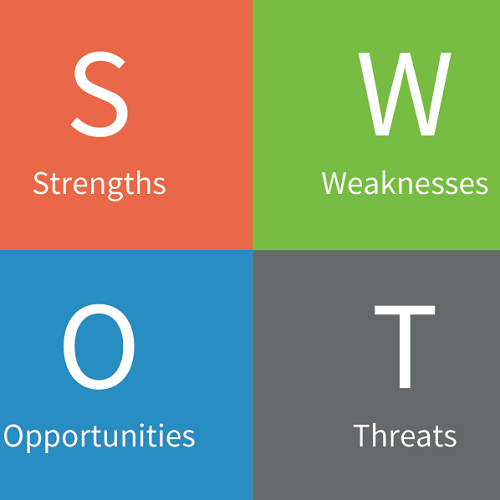
A strengths and weaknesses analysis assesses a company's internal resources against competitors: product, sales, marketing, people and finance. It relies on facts and forms the internal half of a SWOT analysis.
In short
- Strengths and weaknesses are internal factors. Opportunities and threats are external.
- A strength counts only if customers notice it and competitors cannot easily copy it.
- Methods: SWOT, VRIO, Porter's value chain, benchmarking against 3–5 competitors.
- Data comes from the CRM, GA4, Search Console, reviews and customer interviews.
- The output is 3–5 decisions: what to reinforce, what to fix, what to outsource.
What counts as a company's strengths and weaknesses?
Anything the company controls: product, pricing, people, processes, technology, cash and reputation. Markets, regulation, exchange rates and competitor moves belong to the external environment and are analysed separately as opportunities and threats.
The key rule: strength is measured against competitors and through the customer's eyes. "An experienced team" is weak if everyone in the market has the same track record. "We reply to an enquiry within 15 minutes, competitors reply the next day" is a fact you can check.
Which analysis methods should you use?
- SWOT. The best-known format. Its internal part (S and W) is the strengths and weaknesses analysis.
- VRIO. Tests a resource with four questions: is it valuable to customers, rare, hard to imitate, and is the company organised to use it? Only a resource that passes all four gives a lasting advantage.
- Porter's value chain. Breaks the business into stages: procurement, operations, marketing, sales and service. It shows where money and time leak.
- Benchmarking. A side-by-side comparison with 3–5 direct competitors on the same parameters.
Which areas should you check?
| Area | What to measure |
|---|---|
| Product and price | Margin by item, share of repeat purchases, reasons for returns |
| Sales | Response time to enquiries, lead-to-payment conversion from the CRM |
| Marketing | Google visibility in Search Console, cost per lead from ads, Google Maps rating |
| Website | Core Web Vitals, working forms, events configured in GA4 |
| People | Key people revenue depends on, and who would replace them |
| Finance | Cash runway of 3–6 months, dependence on a single client |
Where do you get the data?
Start with what you already have: the CRM, accounting, GA4, Search Console, reviews on Google and social media. Add 5–10 short customer interviews: why they chose you and what nearly made them leave. Mystery shopping of your own company and of competitors is also useful.
Write down managers' opinions too. Only items backed by a number or a customer's words make it into the final table.
How do you turn findings into an action plan?
Match internal factors with external ones. A strength plus an opportunity is a growth direction. A weakness plus a threat is a risk zone to close first. This step is covered in our article on strategic alternatives and strategy choice.
Strengths that customers value become the basis of your positioning. Each weakness gets an owner, a deadline and a fix: solve it in-house, hire, or hand it to a contractor.
How do you document the result?
Put the findings into one table with four columns: factor, fact with a number, source, decision. For example: "response time to enquiries: 4 hours on average in the CRM last quarter; hire a second salesperson or set up auto-replies and routing". The table fits on one page and needs no verbal explanation.
Add a line with the date of the next review and who owns it. Without a date the analysis stays a one-off document.
What are the most common mistakes?
- A list of 20 items with no priorities. A workable scope is 3–5 strengths and 3–5 weaknesses.
- Strengths that customers never see on the website or in ads.
- No comparison with competitors.
- Running the analysis once every five years. Update it annually.
Frequently asked questions
How is a strengths and weaknesses analysis different from SWOT?
It is the internal half of SWOT. A full SWOT adds external opportunities and threats and links them to the internal factors.
How many strengths and weaknesses should you list?
Three to five on each side. A longer list blurs priorities and the team does not know where to start.
Who should run the analysis?
The owner together with department heads. An outside consultant helps because they see the company without habitual assumptions and compare it with the market.
How often should you repeat it?
Once a year and before major decisions: entering a new market, launching a product or changing the sales model.
Can a missing website or ads be a weakness?
Yes, if customers search for your service on Google and find competitors instead. You can check this in Search Console, Keyword Planner and the search results.
Need an outside view of your business?
We run a marketing audit: we pull data from your CRM, GA4 and Search Console, compare you with competitors and deliver a prioritised list of decisions.
Contact us
We will answer all your questions.
 DUNS Number: 68-606-2061
 NCAGE Number: A3G3J






 "INNOVA CONSULTING GROUP"


Comments
Write comment