


KPI for sales managers is a set of measurable indicators that link each manager's daily work and pay to the company's sales goals; we design the indicators, formulas and rating scale, and implement them in your CRM and pay system.
Discuss your projectTelegramWhatsApp
In short
- KPIs start from company goals and are broken down to the sales department and each manager.
- A typical set combines results, such as revenue and closed deals, with activity, such as calls and meetings.
- Indicators are introduced in stages, starting with three or four that matter most.
- Calculations run in a spreadsheet or are automated in the CRM.
- You get a written KPI policy and a calculation model the team can check.
What KPI design and implementation includes
- Goals and deadlines. Sales plans by period, product and market, agreed with the owner.
- Project team. Your head of sales, finance or HR contact and our consultants.
- Indicator selection. Revenue or margin per manager, closed deals versus plan, average order value, lead response time, conversion from lead to deal, repeat orders, activity volume.
- Rating scale. Thresholds, weights for each indicator and rules for partial completion.
- Formulas. How each KPI is calculated, from which data source and for which period.
- Pay link. Bonus and commission structure tied to KPIs, plus non-financial rewards.
- Documentation. A KPI policy for managers and a calculation model in Google Sheets or Excel.
- CRM automation. Dashboards and reports in KeyCRM, HubSpot or Pipedrive, so managers see their numbers every day.
Why KPIs are introduced in stages
A system with fifteen indicators on day one confuses managers and turns reports into paperwork. We usually start with three or four indicators that match the current goal, for example revenue, number of qualified meetings, lead response time and conversion to deal. Once the team works with them and the data in the CRM is reliable, new indicators are added as the business needs them. Each change is written into the KPI policy, so managers know the rules before the period starts.
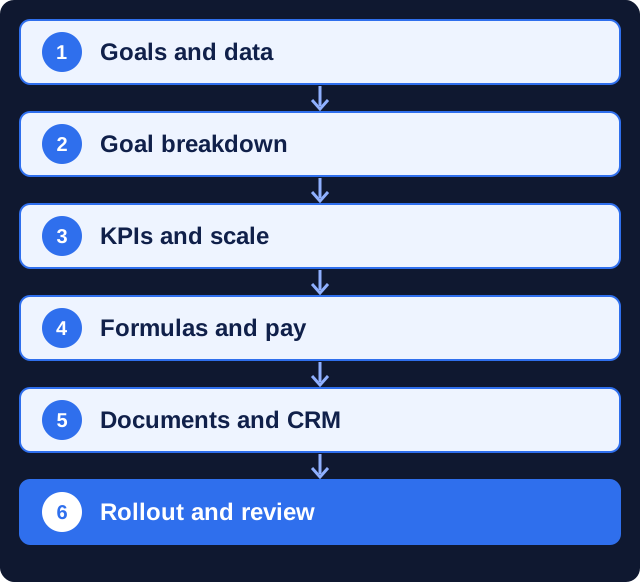
How we build a KPI system
- Goals and data. We agree company goals and check what data the CRM holds.
- Goal breakdown. Goals are split by department, product and manager.
- KPIs and scale. We choose indicators, weights and thresholds.
- Formulas and pay. We write formulas and link KPIs to bonuses.
- Documents and CRM. We prepare the KPI policy and set up dashboards.
- Rollout and review. We present KPIs to the team and review after the first period.
How long does KPI implementation take?
In our experience, designing a KPI system for a sales department usually takes two to four weeks, and the first full period of use follows after that.
It depends on the number of roles, the quality of data in the CRM, whether the pay structure changes, and how quickly the owner approves decisions. If the CRM does not record the needed data, setting it up comes first.
What affects the cost
We quote after the first consultation. The price depends on:
- the number of roles: managers, account managers, heads of sales;
- the complexity of the sales model and product range;
- whether the pay structure is redesigned;
- the level of automation in the CRM;
- support during the first periods of use.
What we need from you
- Sales plans and results for recent periods.
- Current pay and bonus rules.
- Access to the CRM and telephony reports.
- A decision-maker who approves indicators and pay changes.
What you get and how it is measured
KPIs are judged by whether they change behaviour and results:
- a KPI policy (PDF) and a calculation model in a spreadsheet;
- CRM dashboards with each manager's indicators;
- a bonus calculation that managers can check themselves;
- a comparison of plan completion and conversion before and after rollout, based on CRM data.
Why KPI design is safer with an outside team
Badly designed KPIs push managers toward the wrong actions. Typical mistakes:
- indicators copied from another company with a different sales model;
- only activity counted, so managers make calls instead of deals;
- formulas nobody understands, which leads to disputes over pay;
- KPIs based on data the CRM does not record.
Working with a Kyiv team remotely
We work remotely with companies in the UK, the EU and North America: video calls, email, Telegram or WhatsApp, and shared documents for plans and reports. Kyiv is on UTC+2 (UTC+3 in summer), so our working day covers most of the UK and EU business day and the morning on the US East Coast. You get one project manager who is responsible for the timeline.
Why clients trust us
- More than 10 years in digital. Marketing MIX has been building websites and running marketing for over a decade, with the portfolio to show for it.
- Clients outside Ukraine. Our portfolio includes projects for KidSup and Cookiddoo in Canada and MBSoy, an architectural studio in Finland.
- One team for the whole chain. Strategy, website, SEO, ads and analytics sit with one team, so nothing gets lost between contractors.
- A registered, verifiable company. Our DUNS number is 68-606-2061 and our NCAGE code is A3G3J; both can be checked in the Dun & Bradstreet and NATO NCAGE databases.
- A real office in Kyiv. The studio is at 77 Velyka Vasylkivska St., Kyiv, and works remotely with clients in Ukraine and abroad.
FAQ
What KPIs are used for sales managers?
Common ones are revenue or margin per manager, closed deals versus plan, average order value, lead response time, conversion from lead to deal, number of qualified meetings and repeat orders. The set depends on your sales model.
Can I get the KPI system as a PDF?
Yes. The KPI policy for managers is delivered as a document in PDF, and the calculation model as a Google Sheets or Excel file.
How many KPIs should a sales manager have?
Usually three to five at a time. More indicators blur the focus and make pay hard to calculate.
How are KPIs linked to pay?
Through a bonus or commission formula with weights and thresholds for each indicator, written into the KPI policy.
Can KPIs be calculated automatically in the CRM?
Yes, in KeyCRM, HubSpot, Pipedrive and similar systems, if deals, calls and tasks are recorded consistently.
How do we start working together?
With a call about your sales department and goals. After it we send a proposal with scope, stages and timeline.
How often should KPIs be reviewed?
We review them after the first full period and then usually once a quarter, or when goals, products or the market change. Changes are announced before a new period starts.
Related services
- Sales department audit
- Sales department automation
- Sales department management and support
- Sales manager assessment
- Turnkey sales department
Ready to start? Describe your task in the form below. A manager replies with questions or a work plan and an estimate.


 DUNS Number: 68-606-2061
 NCAGE Number: A3G3J






 "INNOVA CONSULTING GROUP"