


Advertising in price aggregators places your online store's products on price comparison sites such as Hotline, Price.ua or Google Shopping, where buyers compare offers right before ordering; we prepare the product feed, set up accounts and control cost per click.
Discuss your projectTelegramWhatsApp
In short
- Price aggregators show your products next to competitors' offers to buyers who are ready to order.
- We prepare an XML or CSV product feed from your store and keep prices and stock in sync.
- Most aggregators charge per click; we set bids by category and cut products that do not pay back.
- Traffic and orders are tracked in GA4 with UTM tags for every aggregator.
- The cost depends on catalogue size, number of platforms and the state of your feed.
What is included
- Platform choice. Hotline and Price.ua for Ukraine, Google Shopping for most markets, and local comparison sites in your target country, chosen for your categories.
- Product feed. An XML or CSV feed generated from your CMS with titles, prices, stock, images, brand and category mapping for each platform.
- Account setup. Store registration, company details, delivery and payment terms, and review settings.
- Category mapping. Your categories matched to the aggregator's structure, so products appear in the right lists and filters.
- Bids and budget. Cost per click by category and product group, with daily limits.
- Feed monitoring. Checks for errors, rejected items, out-of-stock products and price mismatches with the site.
- Analytics. UTM tags per platform, GA4 e-commerce events and a report on orders and cost per order.
- Store reviews. Setting up review requests after purchase, since ratings affect clicks on comparison sites.
Which stores benefit most
Price aggregators work best for goods that buyers compare by model and price: electronics, computers, phones, appliances, accessories, tools and auto parts. Buyers arrive already knowing what they want, so the price, delivery terms and store rating decide the click. For goods without clear models, such as handmade items or custom furniture, Google Shopping and search ads usually work better.
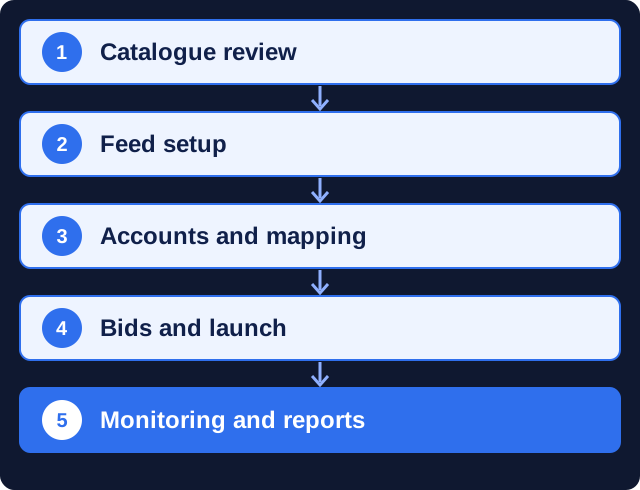
How we launch price aggregator advertising
- Catalogue review. We check your categories, prices and margins and pick platforms.
- Feed setup. We build or fix the product feed for each aggregator.
- Accounts and mapping. We register the store and map categories and delivery terms.
- Bids and launch. We set bids and budgets and launch the listings.
- Monitoring and reports. We fix feed errors, adjust bids and report on orders.
How long does it take to launch?
In our experience, a store with a working feed usually goes live on an aggregator within a few business days of getting access, plus the aggregator's moderation time.
It depends on the platform's moderation rules, the size of the catalogue, and whether your CMS can export a feed or we need to build one. Fixing product data such as missing brands or model codes often takes longer than the setup itself.
What affects the cost
Click costs are paid to the aggregators. Our fee depends on:
- the number of products and categories;
- the number of aggregators and countries;
- whether the feed exists or has to be built;
- how often prices and stock change;
- the depth of ongoing bid management and reporting.
What we need from you
- Access to the store's admin panel or a developer who can add a feed export.
- Company details, delivery and payment terms.
- Margins or target cost per order by category.
- Access to GA4 and permission to add UTM tags.
What you get and how it is measured
Every platform is measured by orders and cost per order:
- clicks, cost and orders by aggregator and category in GA4;
- cost per order compared with your target;
- a list of products that do not pay back and are paused;
- a feed error log with fixes.
Why aggregator advertising needs management
Aggregators charge for clicks whether or not the price on the site matches. Typical losses:
- outdated prices or stock in the feed, which leads to complaints and account warnings;
- one bid for the whole catalogue, so low-margin items use up the budget;
- no UTM tags, so orders from aggregators show up as direct traffic;
- unanswered negative reviews that lower the store rating.
Working with a Kyiv team remotely
We work remotely with companies in the UK, the EU and North America: video calls, email, Telegram or WhatsApp, and shared documents for plans and reports. Kyiv is on UTC+2 (UTC+3 in summer), so our working day covers most of the UK and EU business day and the morning on the US East Coast. You get one project manager who is responsible for the timeline.
Why clients trust us
- More than 10 years in digital. Marketing MIX has been building websites and running marketing for over a decade, with the portfolio to show for it.
- Clients outside Ukraine. Our portfolio includes projects for KidSup and Cookiddoo in Canada and MBSoy, an architectural studio in Finland.
- One team for the whole chain. Strategy, website, SEO, ads and analytics sit with one team, so nothing gets lost between contractors.
- A registered, verifiable company. Our DUNS number is 68-606-2061 and our NCAGE code is A3G3J; both can be checked in the Dun & Bradstreet and NATO NCAGE databases.
- A real office in Kyiv. The studio is at 77 Velyka Vasylkivska St., Kyiv, and works remotely with clients in Ukraine and abroad.
FAQ
What is a price aggregator?
It is a site that collects product offers from many online stores and lets buyers compare prices, delivery terms and store ratings in one list, then go to the chosen store to order.
Which price aggregators do you work with?
In Ukraine, Hotline and Price.ua; internationally, Google Shopping and local comparison sites chosen for your country and categories.
How do I pay for advertising in price aggregators?
Most platforms charge per click to your store; some also offer listing packages. You pay the platform directly, and we manage bids and budgets.
Do I need a product feed?
Yes. Aggregators take product data from an XML or CSV feed. Most CMSs can export one with a module; we set it up or build it.
Can aggregator advertising work for a store outside Ukraine?
Yes. We start with Google Shopping, which covers most countries, and add local comparison sites used in your market after checking their audience, fees and feed requirements.
How is this different from Google Shopping?
Google Shopping is also a comparison service, run through Google Merchant Center and Google Ads. Local aggregators have their own audiences and rules, so many stores use both.
Related services
Ready to start? Describe your task in the form below. A manager replies with questions or a work plan and an estimate.


 DUNS Number: 68-606-2061
 NCAGE Number: A3G3J






 "INNOVA CONSULTING GROUP"