


A complex web platform for a crypto company is a product with user accounts and business logic: crypto exchangers and trading platforms, investor portals, token dashboards, launchpads, staking cabinets, admin panels and integrations with wallets, liquidity and payment providers.
Discuss your projectTelegramWhatsApp
In short
- Typical products: investor and token holder portals, launchpads, staking and rewards cabinets, partner and referral systems, analytics dashboards.
- Stack: Next.js or React front end, Laravel or Node back end, WalletConnect and ethers.js for on-chain actions.
- Smart contracts in Solidity (EVM chains) or for TON when the product needs them, with an independent audit before mainnet.
- The timeline is set after the specification; we launch a first working version, then extend it.
- Exchangers, brokerage and OTC platforms: we build the cabinet, KYC flow and admin panel around a proven or custom trading core.
What a crypto web platform can include
- Accounts and roles. Email or wallet sign-in, 2FA, roles for users, partners and admins.
- Wallet and chain integration. WalletConnect, MetaMask, reading balances and events, signing transactions from the browser.
- Smart contracts. Vesting, staking, claims or sales in Solidity or for TON, tested and audited before mainnet.
- Dashboards. Token balances, vesting schedules, rewards, referral stats and reports.
- Admin panel. Users, allocations, campaigns, content, audit log.
- KYC where required. Integration with the KYC provider you choose for sales or investor sections.
- Notifications and bots. Email and Telegram notifications, support bot.
- Infrastructure. Cloud hosting, monitoring, backups, staging environment.
Crypto exchange and trading platforms
- User cabinet. Registration, two-factor authentication, balances, deposit and withdrawal requests, history and statements.
- KYC and AML flow. Integration with the KYC provider you choose, risk flags and manual review screens for compliance staff.
- Order and exchange flows. Rate calculation, fixed and floating rates for exchangers, limits and fees set by admins.
- Integrations. Liquidity providers and exchange APIs, custody or wallet infrastructure, card and bank payment providers.
- SEO portals. Rate monitors, comparison and news sites with structured data that send users to the platform.
The matching engine and custody are the riskiest parts. Often it is safer to license a proven provider and build the platform around it; we compare both options during discovery. In the EU, MiCA (Regulation (EU) 2023/1114) requires crypto-asset service providers to be authorised, and the travel rule of Regulation (EU) 2023/1113 applies to crypto transfers. We build the flows and logs your compliance officer asks for; licensing stays with your legal counsel. If you need smart contracts without a large web product, see blockchain development.
Crypto advertising rules we plan around
Ad platforms restrict crypto promotion. Google Ads requires certification for crypto exchanges and wallets in many countries, and Meta asks for written permission and licence details before crypto ads run. In the EU, the MiCA regulation (Regulation (EU) 2023/1114) requires marketing communications about crypto-assets to be fair, clear, not misleading and consistent with the white paper. We write copy without promises of returns and check the rules for your markets before launch. Licensing questions stay with your legal counsel.
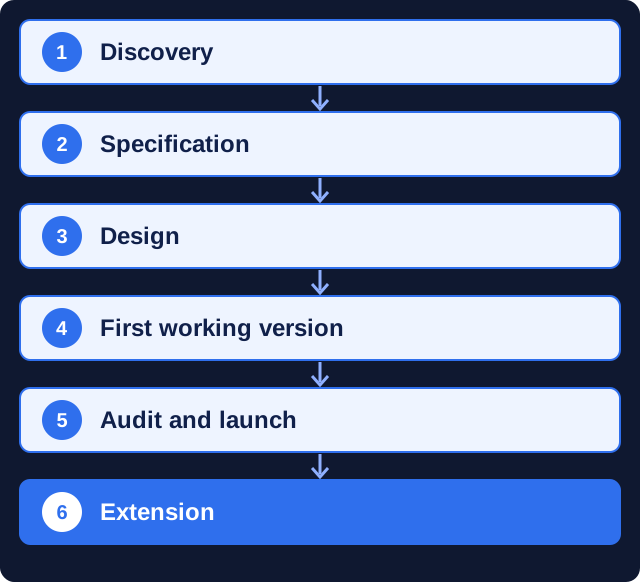
How a platform project goes
- Discovery. Users, flows, on-chain and off-chain parts.
- Specification. Modules, integrations, security needs.
- Design. Cabinet and admin screens, prototypes.
- First working version. Core flows on testnet.
- Audit and launch. Contract audit, security test, mainnet release.
- Extension. New modules based on usage data.
How long does a crypto web platform take?
We set the timeline after the specification, because platforms differ widely in scope. We usually agree a first working version with the core flows, tested on testnet, and extend it in stages.
The public site and landing pages can launch earlier: a landing page in up to 3 working days and a corporate site in up to 10 working days after materials are agreed. Smart contract audits by an independent firm follow their own schedule, which we plan in from the start.
What affects the cost of a crypto platform
We quote after the specification. The main factors:
- number of modules and user roles;
- smart contracts and their audit;
- number of chains and wallets supported;
- KYC and payment integrations;
- load and security requirements;
- support after launch.
What we need from you
- Product description, target users and business model.
- Tokenomics and contract logic, if contracts are needed.
- Compliance requirements from your lawyers.
- A product owner for weekly decisions.
What you get and how we measure it
We agree the measures of success before development:
- core flows working end to end on testnet, then on mainnet;
- audit and penetration test reports with fixes;
- analytics for sign-ups, wallet connections and key actions;
- documentation and access handed over to your team.
Why a crypto platform needs a contracted team
What goes wrong most often in crypto platforms:
- contracts deployed to mainnet without an independent audit;
- admin keys held by one person with no multisig;
- front ends open to phishing through unverified links and domains;
- no staging environment, so every fix is tested on users.
Working with a Kyiv team remotely
We work remotely with companies in the UK, the EU and North America: video calls, email, Telegram or WhatsApp, and shared documents for plans and reports. Kyiv is on UTC+2 (UTC+3 in summer), so our working day covers most of the UK and EU business day and the morning on the US East Coast. You get one project manager who is responsible for the timeline.
Why clients trust us
- More than 10 years in digital. Marketing MIX has been building websites and running marketing for over a decade, with the portfolio to show for it.
- Clients outside Ukraine. Our portfolio includes projects for KidSup and Cookiddoo in Canada and MBSoy, an architectural studio in Finland.
- One team for the whole chain. Strategy, website, SEO, ads and analytics sit with one team, so nothing gets lost between contractors.
- A registered, verifiable company. Our DUNS number is 68-606-2061 and our NCAGE code is A3G3J; both can be checked in the Dun & Bradstreet and NATO NCAGE databases.
- A real office in Kyiv. The studio is at 77 Velyka Vasylkivska St., Kyiv, and works remotely with clients in Ukraine and abroad.
FAQ
What is a complex web project for a crypto company?
A platform with accounts and business logic: investor portals, token dashboards, launchpads, staking or referral cabinets, with admin panels and blockchain integrations.
How long does it take?
We set the timeline after the specification and usually launch a first working version with core flows before extending it.
Which technologies do you use?
Next.js or React, Laravel or Node, WalletConnect and ethers.js, smart contracts in Solidity or for TON when needed.
Do you audit smart contracts?
We test contracts ourselves and plan an independent audit before mainnet. The audit firm is chosen with you.
Can you add KYC?
Yes, through integration with the KYC provider you choose, for sales or investor sections.
Can you build a crypto exchanger website?
Yes: rate calculation, orders, KYC, admin panel and integrations with payment and liquidity providers.
Should we build our own matching engine?
Often it is safer to license a proven engine and custody provider and build the platform around them. We compare both options during discovery.
How much does a crypto platform cost?
It depends on modules, contracts, integrations and security needs. We quote after the specification.
Related services
- Blockchain development
- Mini apps for crypto companies
- Cybersecurity audit
- Services for crypto companies
Ready to start? Describe your task in the form below. A manager replies with questions or a work plan and an estimate.


 DUNS Number: 68-606-2061
 NCAGE Number: A3G3J





 "INNOVA CONSULTING GROUP"